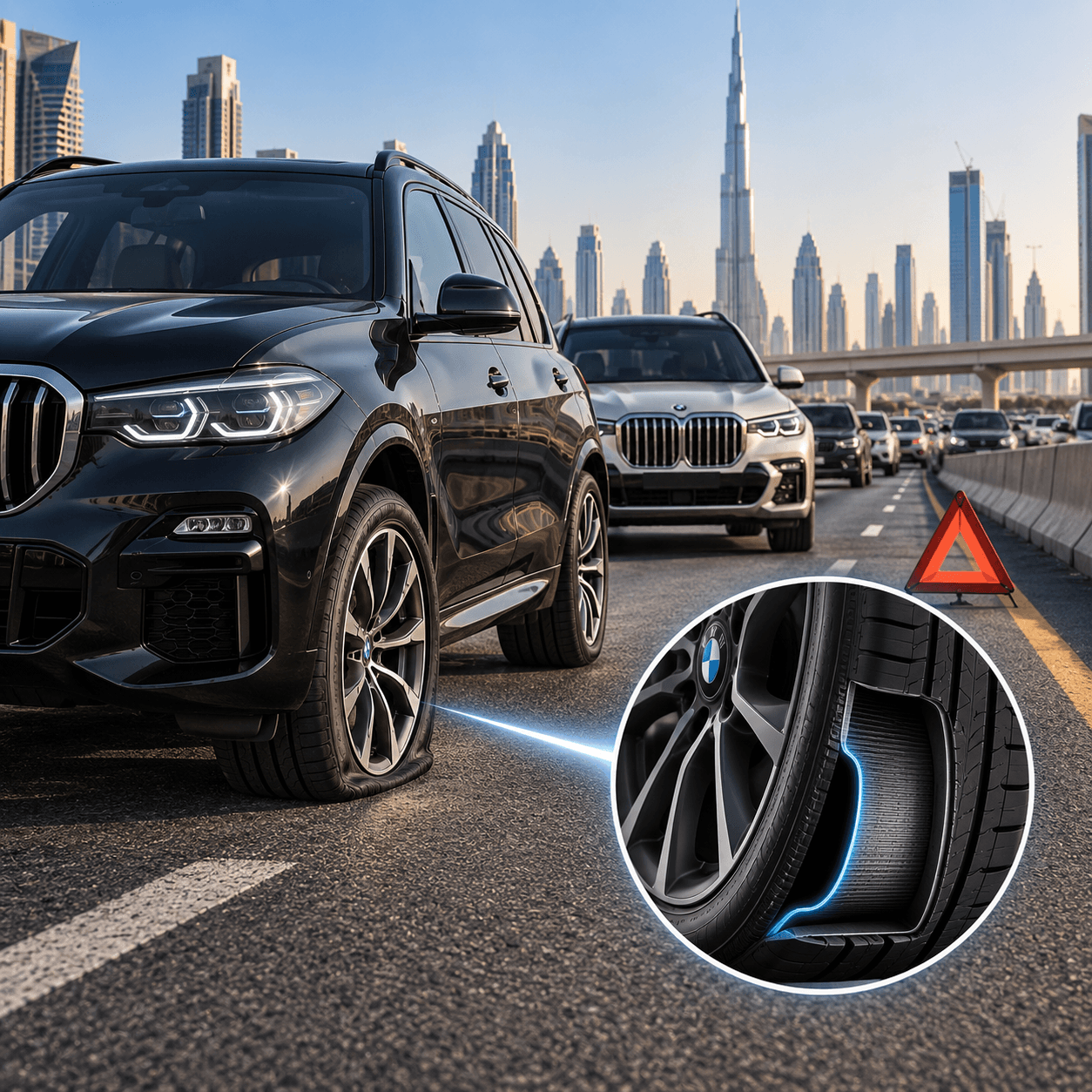

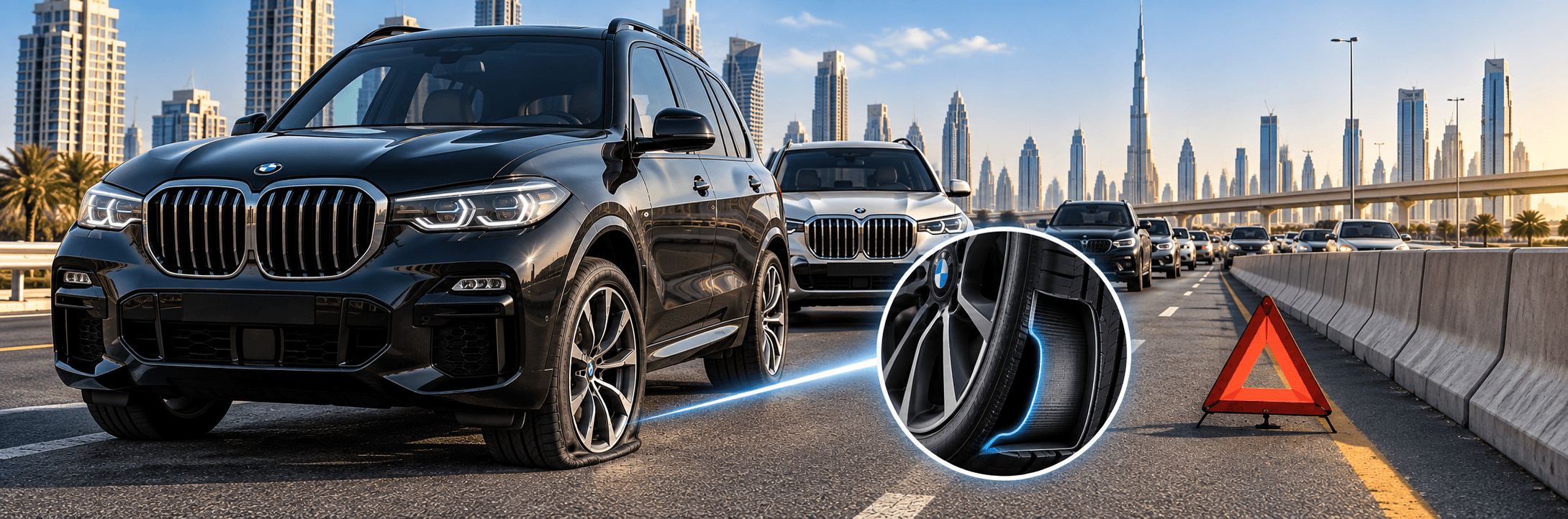
When a run-flat tyre on your BMW X5 or X7 loses pressure in Dubai traffic, its reinforced structure is designed to support the vehicle temporarily instead of immediately collapsing like a conventional tyre. This limited mobility can help you move away from active traffic and reach a safer location or professional tyre shop without having to change a large SUV wheel at the roadside.
Run-flat tyres, however, are not puncture-proof and cannot be driven indefinitely after losing pressure. According to BMW, run-flat tyres allow a vehicle to continue driving temporarily after a puncture, but only within specified speed and distance limits.
For X5 and X7 owners, understanding these limits is particularly important because these are heavier SUVs that may use large wheels, different front and rear tyre sizes, and model-specific BMW tyres.
What Actually Happens When a BMW Run-Flat Loses Pressure?
A conventional tyre relies heavily on internal air pressure to maintain its shape and support the vehicle's load. After substantial pressure loss, its sidewall can collapse, making continued driving unsafe and potentially damaging the tyre and wheel.
A run-flat tyre uses reinforced sidewalls designed to temporarily support the vehicle following significant pressure loss.
However, the tyre is no longer operating under normal conditions. With little or no inflation pressure, the reinforced sidewalls carry considerably more load and flex differently as the wheel rotates. This generates additional heat and places greater stress on the tyre structure. Run-flat technology should therefore be understood as temporary mobility after pressure loss, not permission to continue driving normally.
How Will You Know the Tyre Has Gone Flat?
Because a run-flat tyre may retain much of its external shape after losing pressure, the driver may not immediately recognise a puncture through appearance or vehicle behaviour alone. This is why tyre-pressure monitoring is particularly important on vehicles equipped with run-flat technology.
- Reduce Speed Smoothly
Avoid sudden acceleration, aggressive cornering, and hard braking. A deflated run-flat no longer has the same operating characteristics as a correctly inflated tyre.
- Find a Safe Location
Dubai traffic is not the place to stop abruptly unless the vehicle has become unsafe to control. Move away from active traffic when possible and inspect the situation somewhere safer.
- Identify the Affected Tyre
Check which tyre has triggered the pressure warning. Visible sidewall damage, severe deformation, vibration, or unstable handling are reasons not to continue driving simply because the tyre carries run-flat technology.
How Far Can You Drive on a Flat BMW Run-Flat?
BMW's general guidance states that its run-flat tyres can provide continued mobility for up to approximately 50 miles (80 km) at a maximum speed of 50 mph (80 km/h) after pressure loss. However, the exact instructions applicable to the tyre and vehicle should always take priority.
Actual remaining mobility can be affected by vehicle load, tyre condition, ambient temperature, severity of damage, road conditions, and how far the tyre has already travelled after losing pressure.
For a BMW X5 or X7 in Dubai, the objective should therefore be to reach a safe inspection point as soon as practical rather than deliberately using the entire available run-flat distance.
Why Does Dubai Heat Matter After Pressure Loss?
Heat becomes more important once a run-flat tyre is operating without normal inflation pressure. The reinforced sidewall must flex while supporting a greater share of the vehicle's load, and repeated deformation generates additional internal heat.
Dubai's high ambient temperatures and hot road surfaces can add to these thermal demands. Vehicle weight is also relevant because the BMW X5 and X7 are substantial SUVs. Reducing speed and unnecessary driving after pressure loss therefore helps limit additional stress on the damaged tyre.
Can a BMW Run-Flat Be Repaired After a Puncture?
Do not assume that a punctured run-flat can automatically be repaired simply because the hole appears small.
A technician needs to inspect the tyre and determine:
- Where the puncture occurred
- Size and type of penetration
- Whether the sidewall was damaged
- Whether the tyre was driven while deflated
- Signs of overheating or structural deterioration
- Tyre manufacturer’s repair requirements
Driving without normal pressure can damage the internal structure even when the outside of the tyre still looks acceptable.
Sidewall damage is particularly serious on a run-flat because its reinforced sidewall forms a critical part of the tyre's temporary load-supporting structure after pressure loss.
Should You Replace Only One BMW Tyre?
Replacing one damaged BMW tyres requires more consideration than simply finding another tyre with the same dimensions. X5 and X7 specifications vary according to model, wheel package, drivetrain, and production configuration. Some versions also use staggered fitments with different front and rear tyre sizes.
- Exact Tyre Size : Match the approved width, aspect ratio, and wheel diameter for that axle.
- Load and Speed Rating : A replacement must meet the required load-carrying and speed specifications.
- Tyre Construction : Confirm whether the existing setup uses run-flat or conventional tyres rather than mixing constructions without understanding the consequences.
- Remaining Tread : A large tread-depth difference between tyres may affect vehicle behaviour. On an all-wheel-drive vehicle, replacement decisions should consider the condition and rolling characteristics of the other tyres rather than evaluating the punctured tyre alone.
What Should You Do If the Tyre Is Too Damaged to Drive?
Run-flat capability should never override obvious signs that the vehicle is unsafe to continue driving.
Stop at the nearest safe location if you experience severe vibration, unstable steering, visible tyre separation, major sidewall damage, wheel damage, or a significant change in vehicle handling.
In these situations, roadside or mobile tyre assistance is safer than attempting to reach a tire shop Dubai on a severely damaged tyre. Mobile assistance can be particularly useful for an X5 or X7 because handling and replacing a large SUV wheel beside busy Dubai traffic may be difficult and unsafe.
What Should You Check When Buying Replacement BMW Tyres?
Before you buy tyres online Dubai, confirm:
- Exact front and rear tyre sizes
- Load index
- Speed rating
- Run-flat specification
- BMW-approved fitment where required
- Existing tread condition
- Manufacturing information
- Wheel condition after the puncture
Even the best tyres offer provides poor value if the replacement does not correctly match the BMW's wheel, axle, load, speed, and tyre-construction requirements.
Conclusion
A run-flat tyre gives BMW X5 and X7 drivers an important advantage after pressure loss: limited mobility to leave active traffic and reach a safer location. It does not make a punctured tyre safe for unrestricted driving. Once a pressure warning appears, reduce speed, avoid unnecessary distance, and arrange professional inspection because deflated operation can cause internal damage that is not visible from outside.
For drivers looking for BMW tyres, run flat tyres, or a professional tire shop Dubai, Dial A Tire offers tyre options and fitting services for different vehicle requirements. Customers can also buy tyres online Dubai and arrange mobile tyre assistance when travelling to a workshop is impractical.