
What Is Parasitic Battery Drain and How Can You Find It?
Parasitic battery drain is the hidden drain of your car battery that continues after your engine is turned off. A small amount of this drain is generally normal, but any draining at levels above 50-100 mA after the engine is turned off should be investigated using a multimeter, which will allow you to pinpoint the issue.
Your car's battery works, even when the engine is turned off. Systems like the clock, car alarms, ECU memory, and keyless entry receiver work normally, consuming a small amount of power. However, parasitic battery drain starts when something consumes much more power than it has to, which leaves you with a weak or dead battery.
What is Parasitic Battery Drain?
Parasitic drain is an electrical drain on the car's battery that occurs when the car enters sleep mode. The typical resting drain is usually somewhere between 20-50 mA, depending on the car model. A steady draw that persists at 50-100 mA or more once the car enters sleep mode means there might be an issue with the electrical system.
What Are The Common Causes Of Parasitic Battery Drain?
If your battery is draining more than the accepted limit, then there might be some underlying issue like:
- Aftermarket Accessories: Aftermarket accessories like dash cameras, GPS systems, and stereos draw power from the battery all the time if connected to it directly.
- Stuck Relay Switch: A stuck relay causes some part of the electrical system to stay on after turning off the ignition.
- Wiring Issue: Damaged or poorly connected wires can create unwanted electrical paths.
- Defective Electrical Part: A malfunctioning switch, sensor, module, or boot light draws power from the battery.
- Alternator Failure: The failure of the alternator diode causes reverse flow of electricity from the battery to the alternator when the engine is turned off.
- Electrical Items: Phone chargers, portable refrigerators, etc can keep drawing power from the battery even when the vehicle is parked.
What Are The Signs Of Parasitic Battery Drain?
When your battery experiences extra battery drain, it gives signals to protect you from unexpected battery failure:
- The battery keeps draining its charge even when left unattended overnight or for several days.
- Slow Engine Crank shows that the battery is being discharged when the vehicle remains stationary.
- If a new battery becomes flat soon, then there could be an electrical drain problem.
- Dim dashboard, interior, and headlights may show problems with battery charging.
How To Test For Parasitic Battery Drain?
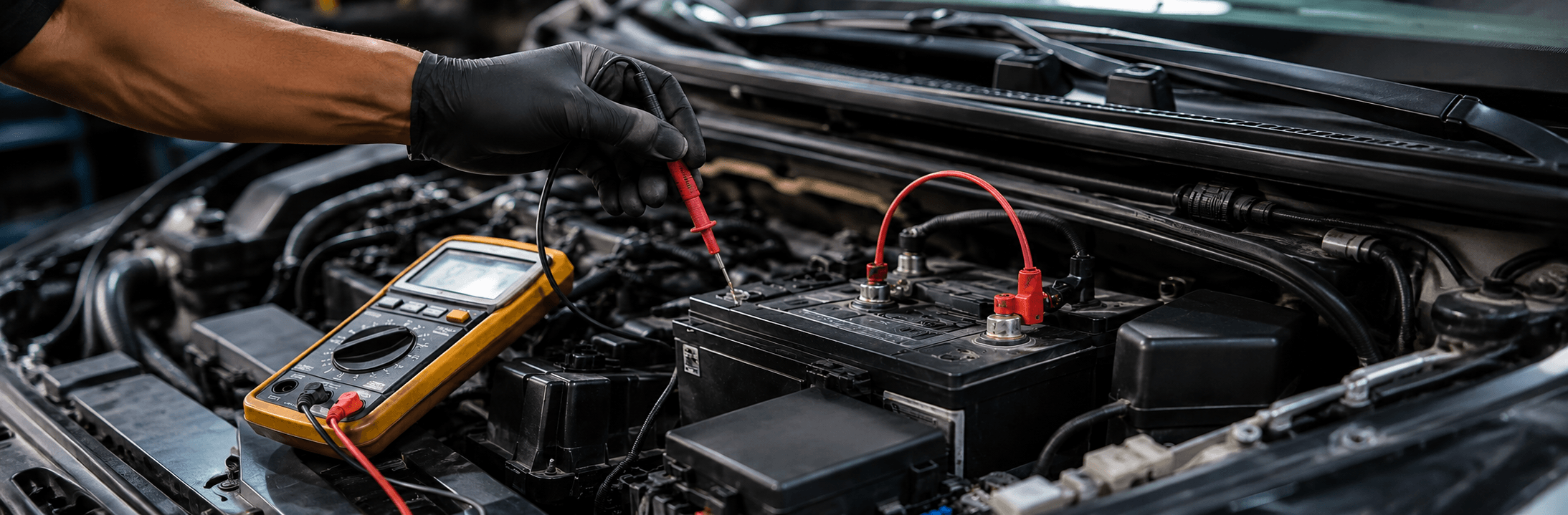
A digital multimeter can help you detect if the battery is draining even when the car is not running.
- Switch Off the Car and Accessories : Shut down the car, turn off all the accessories, and close the doors and trunk.
- Put the Vehicle into Sleep Mode : Wait for about 20 to 30 minutes so that the ECU and other electric components shut down.
- Adjust the Multimeter : Set it to DC amperage and begin with the highest current setting, usually 10A. Ensure the test leads are connected to the correct ports before testing.
- Disconnect the Negative Battery Cable : Ensure that you disconnect the negative cable with the ignition off.
- Connecting the Multimeter in Series : One lead should connect to the negative battery terminal while the other end connects to the cable.
- Checking the Current : A value of around 20-50 mA is normal, while anything over 100 mA requires further assessment.
- Fuse Removal Test : In case the current draw is too high, start removing fuses one at a time and note any considerable change.
- Locate the Source of the Problem : Refer to the fuse diagram and identify which system is connected to the fuse that dropped the current.
What Are The Safety Measures To Take When Testing Parasitic Battery Drain?
Testing of electrical connections should be done carefully to avoid damage to both the meter and the car electrical components.
- The engine must not be cranked while testing with the multimeter in current mode.
- The meter leads should be properly inserted into the appropriate current ports.
- Give enough time for vehicle modules to enter sleep mode.
- Avoid starting up any device that draws a high current during testing.
How To Fix Parasitic Battery Drain?
The first thing you need to do to resolve parasitic draw problems is to find which circuit is using electrical energy.
- Make sure that dashcams, GPS navigators, and stereos use a switched ACC circuit.
- Replace any defective switch, sensor, relay, or other component.
- If the control module does not go into sleep mode, professional diagnostics may be needed.
- Sometimes, a faulty door or boot light switch may make one of the lights stay on when the car is off.
- There may be a fault in the alternator diode, and fixing it could be the solution.
- Fixing the poorly connected wires can also fix the problem.
When Should You Call a Professional for Battery Drain?
Seek help from professionals like Dial A Tire if the battery keeps draining, if the source of the problem is hard to find, or if there is any burning smell, damaged wiring, or strange electrical behavior.
How to Prevent Car Battery Drain?
Battery drain prevention is better than a battery drain solution; therefore, you should include the following steps in your car maintenance.
- Before leaving the car, make sure all the lights are turned off, all the doors are shut, and there are no other devices plugged in.
- Make sure dash cameras and other devices are connected to the right AC power circuit or voltage cut-off systems.
- Routine checking of the battery helps detect either a weak or old battery early.
- High temperatures will reduce battery life; hence, consider parking under shade or covered places.
Conclusion
Parasitic battery drain can leave an operational car unable to start. But diagnosing the problem early can prevent frequent need for a jumpstart and car battery replacement.
At Dial A Tire, we can assist in identifying battery issues by offering professional car service, battery service, car battery replacement, and car electrical repair.