
When shopping for tyres in the UAE, price is often the first consideration. With a wide range of budget tyre options available across online platforms and retail stores, it is tempting to choose the cheapest option and move on. However, the upfront savings from low-cost tyres rarely reflect the full picture. The true cost of cheap tyres reveals itself over time through accelerated wear, increased fuel consumption, compromised safety, and expensive repairs.
In a country where extreme heat, high-speed highways, and dense city traffic all place significant demands on tyres, the quality of rubber you choose directly affects your safety and long-term running costs.
Evaluating tyres purely on purchase price ignores the broader total cost of ownership (TCO) — a framework that accounts for replacement cycles, fuel penalties, maintenance, and accident-related expenses over the full life of the tyre. Understanding the hidden expenses behind budget tyres is essential for any UAE driver looking to make a genuinely informed purchasing decision.
Why the UAE Demands More from Your Tyres?
The UAE presents one of the most demanding tyre environments in the world. Summer temperatures regularly exceed 45 degrees Celsius on the road surface, with asphalt temperatures often climbing above 70 degrees Celsius during peak months. These conditions accelerate polymer degradation and the chemical breakdown of tyre rubber, particularly in low-quality compounds that lack heat-resistant additives. Budget rubber formulations typically have a lower resistance to heat cycle degradation — the cumulative structural weakening that occurs each time a tyre heats up and cools down during a drive cycle.
Over repeated cycles in UAE conditions, this process compromises carcass integrity and reduces the tyre's ability to maintain its designed shape and performance characteristics. Beyond temperature, UAE roads demand consistent performance across very different driving contexts. Drivers navigate high-speed inter-emirate highways, congested urban streets in Dubai and Abu Dhabi, and occasionally rough desert or construction-adjacent roads. Each of these environments stresses tyres differently, and cheap tyres are rarely engineered to handle such varied demands reliably.
Premium tyre brands invest heavily in compound research and tread engineering specifically designed for hot-climate performance, something budget alternatives consistently compromise on. It is also worth noting that tyre age and shelf life become critical in the UAE climate — even a tyre that has not been driven extensively can deteriorate rapidly when stored or used in sustained high ambient temperatures, making tyre manufacturing date a relevant purchase consideration.
Faster Tread Wear Means More Frequent Replacements
One of the most direct hidden costs of cheap tyres is significantly shorter tread life. Cheap tyres use lower-grade rubber compounds and simpler tread designs that wear down faster, particularly under the thermal stress of UAE roads. The tyre compound hardness of budget options is frequently optimised for low production cost rather than durability, resulting in a softer compound that offers initial grip but deteriorates rapidly under sustained heat and load.
A set of budget tyres that appears affordable at AED 150 to 200 per unit may need replacing within 20,000 to 25,000 kilometres, while a reputable mid-range or premium tyre can last 50,000 kilometres or more under similar conditions. Uniform Tyre Quality Grading (UTQG) ratings — which score tyres on treadwear, traction, and temperature resistance — are a useful reference point when comparing longevity across tyre categories. Budget tyres typically carry significantly lower treadwear grades than mid-range and premium alternatives, reflecting their reduced durability under real-world driving conditions.
When calculated over the lifespan of a vehicle, the cumulative replacement cost of cheap tyres consistently exceeds that of higher-quality options. Drivers who focus solely on the per-tyre purchase price without considering tyre longevity end up spending considerably more over two to three years of regular driving. The replacement cycle also carries indirect costs including fitting fees, balancing charges, and time lost during installation appointments.
The Fuel Efficiency Penalty of Budget Tyres
Rolling resistance is a critical but often overlooked tyre characteristic that directly affects fuel consumption. Tyres with high rolling resistance require the engine to work harder to maintain speed, increasing petrol or diesel consumption over time. Premium and mid-range tyres are typically engineered with low rolling resistance compounds — often incorporating silica compound formulations — and optimised tread patterns that reduce friction against the road surface.
Silica-based compounds are a key advancement in modern tyre chemistry, offering lower heat generation and improved energy efficiency compared to traditional carbon-black compounds used in budget tyres. Budget tyres, in contrast, often use basic rubber formulations that generate more heat and resistance with every kilometre driven.
The eco-label rating system, used across European and increasingly GCC markets, grades tyres on fuel efficiency from A to G — a straightforward indicator that budget tyres consistently score poorly on. In practical terms, a vehicle fitted with cheap high-resistance tyres may consume 5 to 10 percent more fuel than the same vehicle fitted with quality low-resistance alternatives. For UAE drivers who cover significant distances, particularly those commuting between emirates or using their vehicles for commercial purposes, this difference translates into a meaningful increase in monthly fuel expenditure.
Over a year of regular driving, the fuel cost penalty can easily surpass the initial savings made on tyre purchase price. Choosing tyres with a strong tyre performance rating on fuel efficiency is therefore not just an environmental consideration but a direct financial one.
Safety Risks That Carry a Financial and Human Cost
The safety implications of cheap tyres represent the most serious category of hidden cost, and one that cannot be measured purely in financial terms. Budget tyres typically underperform in wet braking, high-speed stability, and heat resistance — three areas that are critical for safe driving on UAE roads.
Although UAE roads are dry for most of the year, sudden rain events cause road surfaces to become extremely slippery due to accumulated dust and oil deposits. In these conditions, aquaplaning — where a layer of water builds between the tyre and road surface, causing complete loss of traction — becomes a serious risk. A tyre's resistance to aquaplaning depends heavily on its tread void ratio and the efficiency with which its channels disperse water from the contact patch. Budget tyres with shallow or poorly designed tread patterns offer significantly less aquaplaning resistance, making stopping distance critically longer in wet UAE conditions.
At highway speeds of 120 kilometres per hour or above, budget tyres are more susceptible to sudden pressure loss, tread separation, belt separation, and blowouts, all of which can lead to loss of vehicle control. The financial consequences of a single tyre-related accident can include vehicle repair costs, insurance claim excess payments, medical expenses, traffic fines, and potential legal liability. These costs can reach tens of thousands of dirhams, making the initial saving on cheap tyres entirely insignificant by comparison. It is also worth noting that modern vehicles equipped with a Tyre Pressure Monitoring System (TPMS) may generate false reassurance — TPMS alerts drivers to pressure loss after it has already occurred, but it cannot compensate for a structurally compromised tyre that fails without warning.
Blowout Risk in Extreme UAE Heat
Tyre blowouts are disproportionately common in the UAE during summer months, and budget tyres are significantly more vulnerable to this failure mode. When a tyre is under-engineered for heat resistance, prolonged exposure to high asphalt temperatures combined with highway speeds causes internal tyre pressure to build rapidly. If the tyre structure cannot manage this pressure fluctuation, catastrophic failure becomes a real risk.
Dynamic stiffness — the tyre's ability to maintain structural shape under load and heat — is a key engineering characteristic that separates quality tyres from budget alternatives. Quality tyres feature reinforced internal structures, heat-dissipating compounds, and robust sidewall construction designed to withstand UAE summer conditions. Budget alternatives often cut costs in exactly these structural areas, producing a tyre that performs adequately in mild conditions but fails under sustained thermal and mechanical stress.
The cost of a blowout at highway speed extends far beyond the tyre replacement itself, potentially involving wheel rim damage, suspension impact, bodywork repair, and towing fees. Drivers of vehicles not equipped with run-flat tyres face the additional risk of losing control at the moment of failure, since run-flat technology allows continued driving at reduced speeds after pressure loss — a safety feature entirely absent in the budget tyre category.
Suspension and Alignment Damage from Poor Tyre Quality
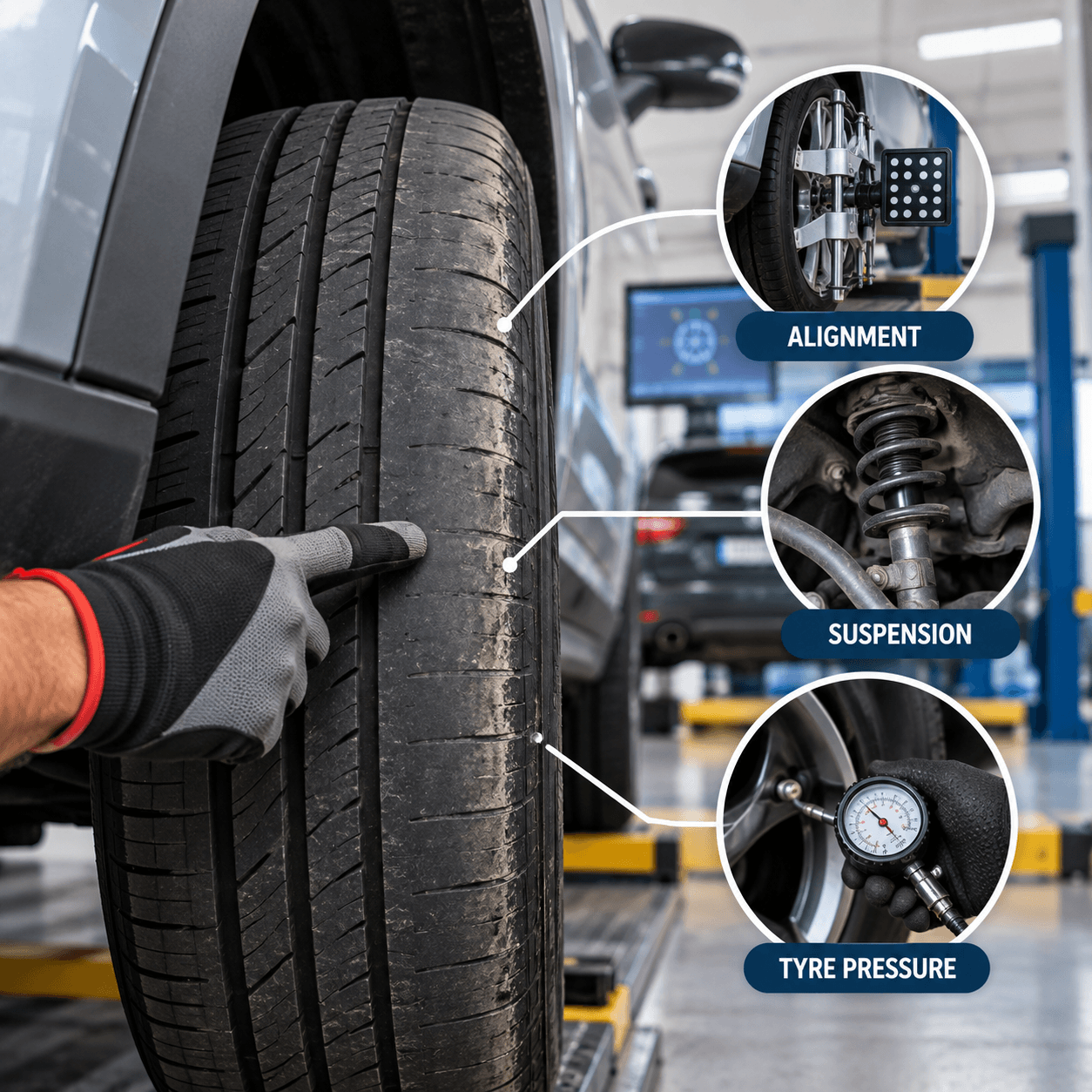
Cheap tyres often have inconsistent construction quality, including uneven weight distribution, imprecise tread geometry, and sidewall rigidity variations. When a tyre is not manufactured to consistent standards, it creates vibration and imbalance at road speed that places additional stress on wheel bearings, suspension components, and steering systems.
Static and dynamic balancing during professional installation can partially compensate for minor weight distribution inconsistencies, but it cannot correct fundamental manufacturing defects in tyre uniformity. Over time, vibrations from poorly balanced budget tyres accelerate wear on components that are expensive to repair or replace, including shock absorbers, ball joints, tie rods, and hub bearings.
Kerb impact resistance is another area where budget tyres consistently fall short — their weaker sidewall construction is more likely to sustain internal damage when a wheel strikes a kerb, speed bump edge, or pothole at speed, transmitting disproportionate force into the suspension. Wheel alignment is also affected when tyre uniformity is poor, because irregular wear patterns force suspension geometry out of specification more quickly.
In the UAE, where vehicles frequently encounter speed bumps, uneven road edges, and construction zone surfaces, the mechanical stress placed on suspension is already considerable. Adding poorly constructed tyres to this equation compounds wear and increases the frequency and cost of mechanical maintenance.
UAE workshops regularly identify suspension damage in vehicles running budget tyres, and the repair bills associated with this damage consistently exceed what was saved at the point of tyre purchase. Ensuring tyres meet original equipment manufacturer (OEM) specifications for size, load index, and speed rating is a baseline requirement that budget tyres sometimes fail to meet accurately, further compounding alignment and handling issues.
Noise, Comfort, and the Indirect Costs of Budget Tyres
While not as financially significant as safety or mechanical damage, the reduction in ride quality associated with cheap tyres carries real costs for drivers who spend substantial time behind the wheel. Budget tyres are typically louder, produce more road vibration, and deliver less predictable vehicle handling and cornering stability than quality alternatives. The tyre noise rating, measured in decibels and assessed as part of the EU tyre labelling system, is an objective measure of cabin noise contribution — budget tyres routinely occupy the lowest performance bands on this scale.
For professionals who drive extensively in the UAE, whether in sales roles, logistics, or daily inter-emirate commutes, this translates into increased driver fatigue and reduced concentration over time. Studies in automotive ergonomics have consistently found a relationship between vehicle noise levels and driver stress and reaction time. Poor tyre quality also reduces steering responsiveness and feedback, making it harder to detect changes in road surface or maintain precise control during lane changes and overtaking manoeuvres.
The tyre stiffness index — a measure of how a tyre responds to lateral and longitudinal forces — directly influences handling precision, and budget tyres with inconsistent stiffness characteristics produce vague, unpredictable steering responses. These factors collectively reduce driving safety and comfort in ways that are difficult to quantify but genuinely important for regular UAE road users.
Environmental and Regulatory Considerations
The environmental impact of tyre choice is increasingly relevant for UAE fleet operators, corporate vehicle managers, and environmentally conscious private drivers. Budget tyres generate more hydrocarbon emissions through higher rolling resistance and accelerated tread wear, as worn rubber particles contribute to road surface microplastic contamination.
Their shorter lifespan also means a higher volume of used tyres requiring disposal, placing additional pressure on waste management infrastructure. Responsible tyre disposal is mandated under UAE environmental regulations, and choosing longer-lasting quality tyres directly reduces the volume of waste generated over a vehicle's operational life.
The carbon footprint of a vehicle is meaningfully affected by its tyres — low rolling resistance compounds from quality manufacturers can reduce CO2 emissions by several grams per kilometre, a cumulative saving that becomes significant over high annual mileages. From a regulatory standpoint, tyre labelling regulations in the UAE and GCC are evolving to align more closely with international standards, with tyre safety standards increasingly specifying minimum performance thresholds for wet grip, rolling resistance, and external noise.
Budget tyres that barely meet minimum thresholds provide a false sense of compliance — they may pass regulatory requirements while delivering real-world performance significantly below what quality alternatives offer. Understanding these regulatory dimensions is particularly important for commercial fleet operators who carry liability for the vehicles they operate.
The Role of Nitrogen Inflation and Tyre Rotation in Extending Tyre Life
Regardless of tyre quality, proper maintenance practices play a meaningful role in maximising tyre lifespan and performance. Nitrogen inflation — filling tyres with nitrogen gas rather than standard compressed air — maintains more stable tyre pressure across temperature fluctuations, because nitrogen molecules are larger and escape through tyre walls more slowly than oxygen molecules.
In the UAE, where ambient temperatures can cause tyre pressure to fluctuate significantly between morning and midday, nitrogen inflation is a practical measure that reduces the pressure variance that contributes to uneven wear and increased blowout risk. However, nitrogen inflation provides its greatest benefit when applied to quality tyres with sound carcass construction — it cannot compensate for the structural weaknesses inherent in budget alternatives.
Tyre rotation — moving tyres between wheel positions at regular intervals, typically every 8,000 to 10,000 kilometres — promotes more even tread wear across all four tyres. Front tyres on front-wheel-drive vehicles wear faster due to steering and drive forces, and rotation distributes this wear more evenly. Budget tyres with inconsistent construction often develop irregular wear patterns even with regular rotation, reducing the effectiveness of this practice and accelerating the point at which replacement becomes necessary.
What to Look for When Choosing Tyres in the UAE
Choosing the right tyre for UAE conditions does not necessarily mean purchasing the most expensive option on the market, but it does mean prioritising quality and specification over the lowest available price. Drivers should look for tyres with a speed rating appropriate for UAE highway speeds, typically H (210 km/h) or V (240 km/h) rated as a minimum. Heat resistance ratings, load indices, and tread wear indicators should all be evaluated before purchase.
The tyre performance rating provided through EU-style labelling — covering wet grip, fuel efficiency, and external noise — offers a standardised comparison framework that helps drivers assess value beyond the sticker price. Reputable tyre brands operating in the UAE market, including Michelin, Bridgestone, Continental, Pirelli, and Hankook, offer products specifically validated for hot-climate performance.
Selecting tyres that meet or exceed OEM specifications for your vehicle ensures that the tyre's load index, speed rating, and dimensional characteristics align with what the vehicle manufacturer intended. Mid-range options from established manufacturers often represent the best value proposition, delivering significantly better durability, safety, and fuel efficiency than budget alternatives at a modest price premium.
Purchasing tyres through reliable online platforms or specialist services that include professional installation, static and dynamic balancing, alignment checks, and valve inspection ensures that even a well-chosen tyre delivers its full potential from the moment it is fitted.
The True Cost Comparison: Budget vs Quality Tyres Over Three Years
A realistic cost comparison over a three-year period illustrates clearly why budget tyres are rarely a genuine saving. A set of four budget tyres purchased at AED 600 to 800 total may need replacing twice within three years under typical UAE driving conditions, resulting in a total tyre expenditure of AED 1,200 to 1,600 plus installation costs. By contrast, a set of quality mid-range tyres purchased for AED 1,400 to 1,800 may last the full three years without replacement.
When fuel savings from lower rolling resistance are factored in — reflecting a better eco-label rating and higher fuel efficiency grade — along with reduced suspension maintenance costs and no accident-related expenses, the quality tyre option frequently proves to be the more economical choice over the full ownership period. Applying a total cost of ownership (TCO) lens to this comparison reveals that the true three-year cost of a budget tyre set, inclusive of replacements, fuel penalties, and maintenance, can reach two to three times the headline purchase price.
This calculation does not include the potential cost of a tyre failure or insurance claim related to an accident, which can add tens of thousands of dirhams to the budget tyre total. For UAE drivers who treat their vehicle as a business tool or daily necessity, investing in appropriate quality tyres is a financially sound and safety-responsible decision.
FAQs
Cheap tyres pose a measurably higher safety risk on UAE highways due to inferior heat resistance, lower wet grip performance, and reduced structural integrity at high speeds. UAE highways operate at speeds of up to 120 kilometres per hour, and the combination of sustained speed and extreme summer heat creates conditions that low-cost tyres are rarely engineered to handle safely. Blowout risk, belt separation, tread separation, and longer stopping distances are all more prevalent with budget tyres. Vehicles equipped with TPMS may not receive advance warning of a structurally compromised tyre, making the quality of the tyre itself the primary line of defence on high-speed UAE roads.
Budget tyres in the UAE typically wear out 40 to 60 percent faster than quality mid-range or premium alternatives under similar driving conditions. High asphalt temperatures accelerate polymer degradation and the breakdown of low-grade rubber compounds, reducing tread life to between 20,000 and 30,000 kilometres in many cases. UTQG treadwear ratings provide a standardised comparison — budget tyres typically carry significantly lower ratings than established brand alternatives. Quality tyres engineered with silica compound formulations and heat-resistant additives maintain tread integrity for 50,000 kilometres or more, delivering significantly better value over the vehicle ownership period.
Yes. Budget tyres typically have higher rolling resistance than quality alternatives, which forces the engine to consume more fuel to maintain speed. Tyres incorporating silica compound technology and rated highly on the eco-label fuel efficiency scale consistently outperform budget options in real-world fuel economy. For UAE drivers covering average distances of 1,500 to 2,000 kilometres per month, a 5 to 10 percent increase in fuel consumption from cheap tyres translates to a meaningful annual cost increase that frequently exceeds the initial saving made on tyre purchase price.
Yes. Poorly manufactured budget tyres with inconsistent dynamic stiffness and tread geometry create vibration and imbalance that stresses suspension components, wheel bearings, and steering systems. Their weaker sidewalls also offer reduced kerb impact resistance, transmitting more force into suspension components when wheels strike kerbs or speed bump edges. Over time, this leads to accelerated wear of shock absorbers, ball joints, and tie rods — components that are significantly more expensive to replace than the saving made on budget tyres.
For mixed driving conditions in the UAE, touring tyres or all-season tyres from reputable mid-range or premium manufacturers offer the best balance of durability, heat resistance, and performance. Look for tyres with a minimum H speed rating, a silica compound low rolling resistance formulation, reinforced sidewall construction, and strong aquaplaning resistance indicated by a high wet grip rating on the tyre performance label. Ensure the selected tyre meets your vehicle's OEM specifications for load index and size. Brands such as Michelin, Bridgestone, Continental, and Hankook all offer UAE-validated options across both mid-range and premium tiers that deliver strong performance across city and highway environments without requiring the highest price point in the market.