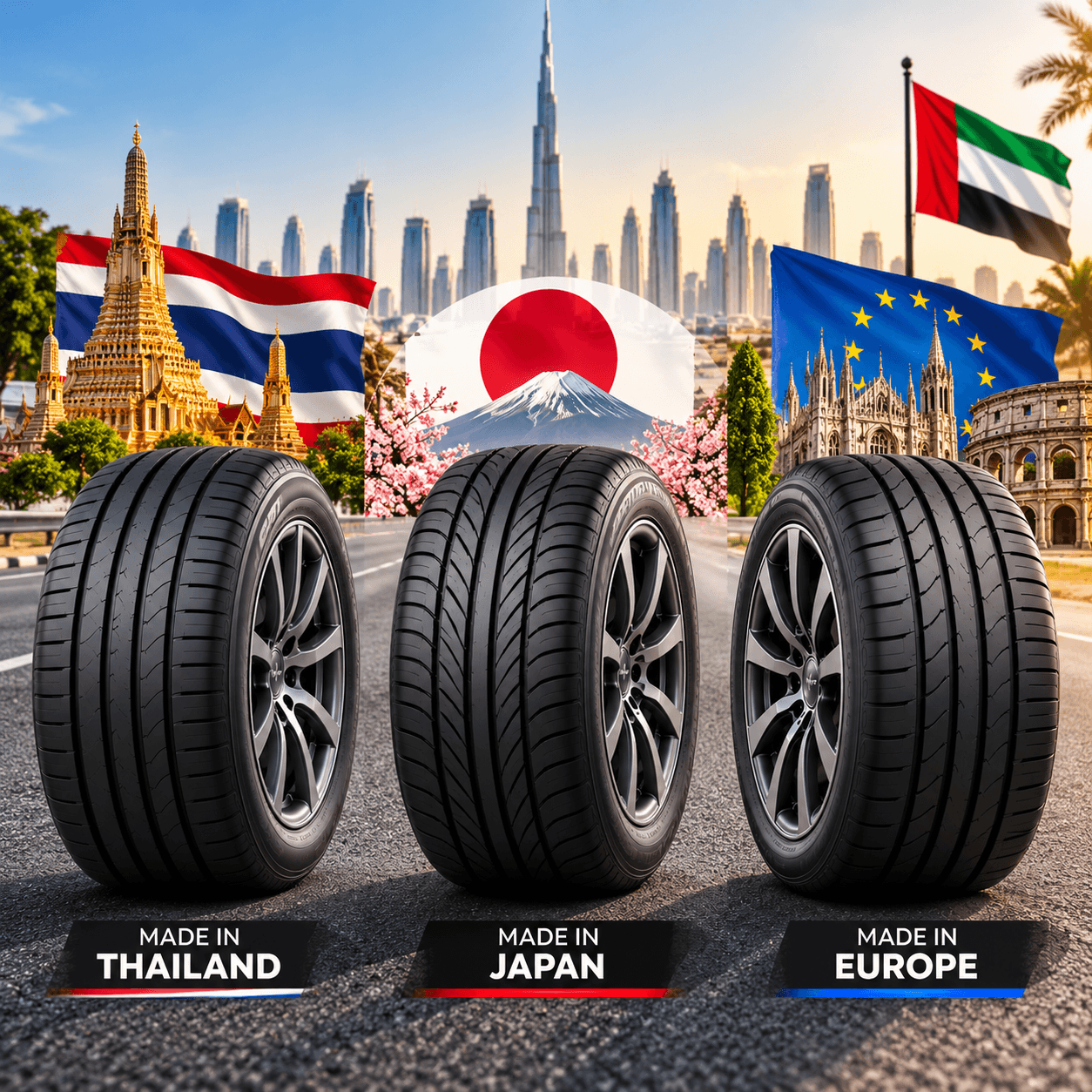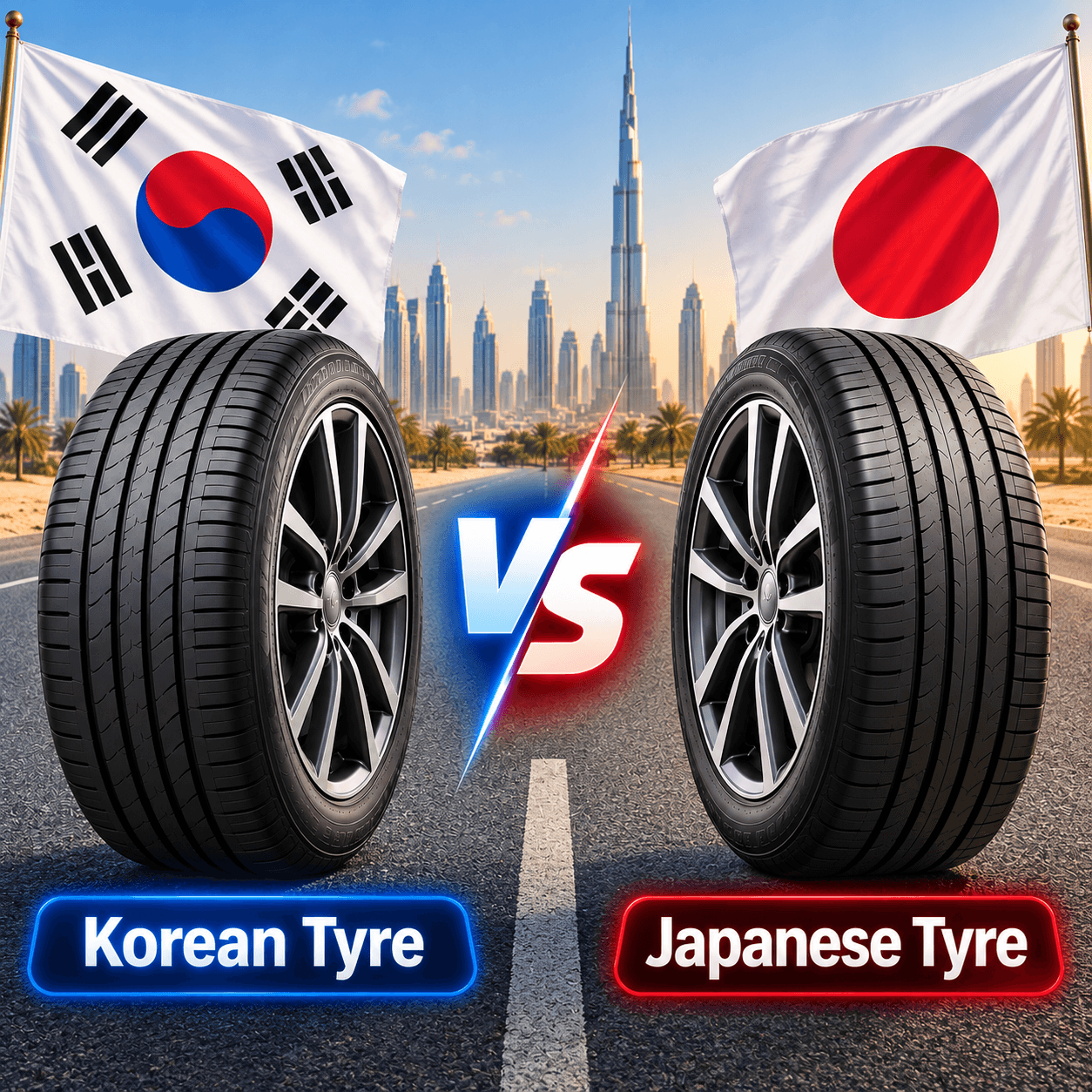

Both Korean and Japanese tyres are good options for UAE drivers. However, country of origin should not be the sole factor when choosing between them. South Korean manufacturers such as Hankook and Nexen compete globally across passenger-car, SUV, and performance tyre categories, while Japan is home to established manufacturers such as Bridgestone, Yokohama, and Toyo.
Hankook, for example, supplies tyres as original equipment to global vehicle manufacturers, while the Japan Automobile Tyre Manufacturers Association includes Bridgestone, Yokohama, Toyo, and Sumitomo Rubber among its members.
The best car tyre depends on the specific tyre model, your vehicle, annual mileage, comfort expectations, driving conditions, and budget. In the UAE, buyers should compare the actual specifications and performance characteristics of individual tyre models rather than assuming that every Japanese tyre is better than every Korean tyre.
What Are the Main Korean and Japanese Tyre Brands?
There are a number of established manufacturers in the UAE tyre market in both countries.
- Popular Korean Tyres
Two well-known Korean tyre manufacturers are Hankook and Nexen. Established in 1941, Hankook now operates globally across passenger-car, commercial-vehicle, and motorsport tyre markets. Nexen also has a long manufacturing history in Korea and began producing vehicle tyres in the 1950s.
Depending on the model, Korean tyres can offer a good balance of purchase price, everyday comfort, tread life, and highway performance.
- Popular Japanese Tyres
Major Japanese tyre manufacturers include Bridgestone, Yokohama, Toyo, and Sumitomo Rubber Industries. Bridgestone was founded in Japan in 1931, and the history of tire development in Yokohama dates back to 1917.
Japanese manufacturers offer a wide range of products, from everyday touring tyres to luxury, SUV, off-road, and high-performance options.
Which Is Better for UAE Summer Driving?
High ambient temperatures and frequent highway driving in the UAE make correct tyre selection and inflation especially important. However, a tyre's country of origin alone does not indicate how well it will perform under these conditions.
- Temperature and Speed Capability
The tyre should meet the vehicle manufacturer's required speed rating and other specifications. Sustained highway driving generates heat through repeated tyre deformation, making correct inflation particularly important.
- Vehicle Load Requirements
SUVs and larger vehicles require tyres with adequate load-carrying capacity. A lower tyre price UAE should never justify fitting a tyre with a load index below the vehicle manufacturer's requirement.
- Correct Inflation
Even a high-quality Korean or Japanese tyre can overheat or wear abnormally when regularly underinflated. UAE drivers should follow the vehicle manufacturer's recommended cold tyre pressure rather than adjusting inflation according to the tyre brand.
Korean vs Japanese Tyres: How Do They Compare?
There is no technical rule stating that Korean tyres are more comfortable or Japanese tyres are more durable. These characteristics vary considerably from one tyre model to another.
| Factor | Korean Tyres | Japanese Tyres |
|---|---|---|
| Brand examples | Hankook, Nexen | Bridgestone, Yokohama, Toyo |
| Everyday options | Widely available | Widely available |
| SUV options | Available | Available |
| Performance tyres | Available | Available |
| Premium/OE options | Available | Available |
| Best choice | Depends on model | Depends on model |
When Do Korean Tyres Make Sense?
Korean tyres are worth considering when you want competitive specifications without automatically choosing the most expensive option in a tyres shop.
Hankook is particularly relevant because it should not be viewed simply as a low-cost alternative. The company supplies original-equipment tyres to global vehicle manufacturers, showing that Korean tyre manufacturers also compete in demanding OEM applications.
Depending on the model, a Korean tyre can be suitable for daily Dubai-Sharjah commuting, highway driving, family cars, SUVs, and drivers looking to balance cost with performance.
The Korean badge is not as important as the particular model.
When Are Japanese Tyres Worth Considering?
Japanese tyres make sense when a specific Bridgestone, Yokohama, Toyo, or other Japanese model matches the driver's vehicle and intended use.
For example, one driver may prioritise low highway noise and ride comfort, while another may need an SUV tyre capable of regular off-road driving. A performance-car owner can opt to emphasise steering reaction and high-speed steadiness.
These different requirements can lead drivers to choose different tyre models even from the same manufacturer.
This is why asking a tyres Dubai retailer for the best Japanese tyre without explaining your vehicle, typical routes, and driving conditions is unlikely to produce a meaningful recommendation.
Does Paying More Mean You Get a Better Tyre?
Not automatically. Tyre price UAE varies according to brand positioning, tyre size, construction, technology, load and speed ratings, product category, and availability.
A more expensive tyre may include performance characteristics that your vehicle or driving conditions do not require. On the other hand, choosing solely by the lowest price may mean compromising characteristics that matter for your driving conditions.
Rather than comparing prices alone, check:
- Correct tyre size
- Load index
- Speed rating
- Highway or off-road use
- Wet and dry performance
- Road-noise characteristics
- Tread design
- Manufacturing information
- Warranty terms
This provides you with a valuable product-to-product comparison.
Which Should You Choose for Your Car?
For everyday UAE driving, start with the specifications required by your vehicle manufacturer and then compare suitable Korean and Japanese tyre models that meet those requirements.
A Dubai commuter may prioritise low road noise and everyday ride comfort. Tread durability and rolling resistance may matter more to a high-mileage driver, while an SUV owner who regularly drives off-road may require a more aggressive tread design.
The country of origin should therefore not take priority over the tyre's actual engineering, specifications, and intended use.
Conclusion
There is no automatic winner between Korean tyres and Japanese tyres for UAE driving. The two nations manufacture tyres in various price and performance levels. A better idea would be to compare each model in terms of the tyre size, load and speed rating, comfort, projected mileage, vehicle type and the real driving conditions.
Drivers comparing tyres Dubai can use Dial A Tire to explore tyre options according to their vehicle requirements and budget. Instead of choosing solely according to tyre price UAE or country of origin, compare the specifications, intended use, and compatibility of each tyre with your vehicle.