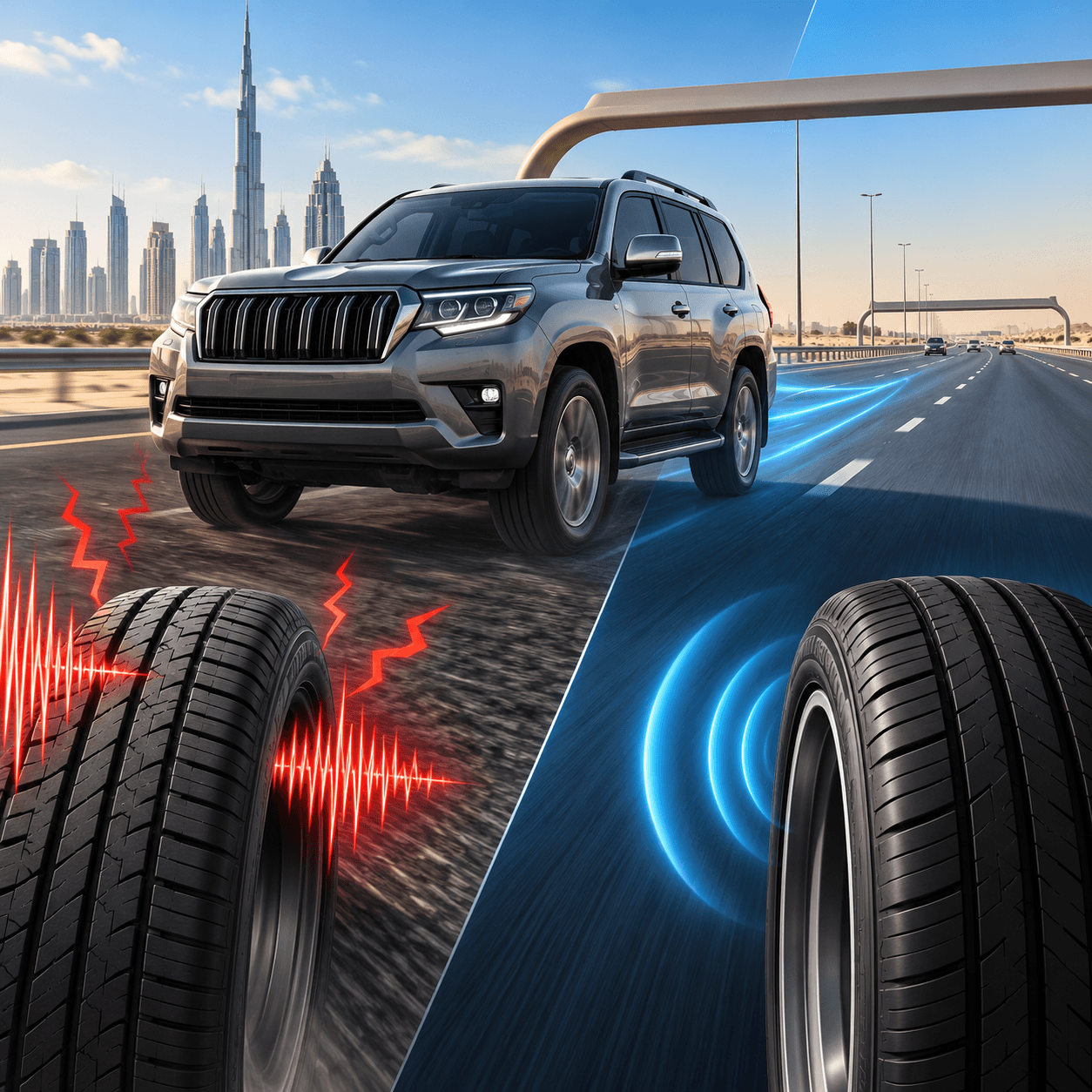

Driving on UAE roads presents a unique set of demands that most motorists in temperate climates never encounter. Sustained highway speeds on Sheikh Zayed Road and Al Khail Road, ambient temperatures that regularly push past 45°C in summer, and the occasional sandy surface condition combine to create an operating environment where tyre specification is not a matter of preference—it is a matter of safety. Among the most misunderstood and frequently overlooked tyre specifications is the speed rating, a single alphanumeric code that communicates the maximum sustained speed a tyre can safely handle.
Many drivers across Dubai, Abu Dhabi, and Sharjah unknowingly install tyres that fall below the speed rating originally specified by the vehicle manufacturer, a decision that carries significant implications for vehicle handling, heat dissipation, braking distance, and roadworthiness in the UAE's demanding conditions. Understanding this specification in full—alongside related criteria such as tyre construction type, tread compound, and load range—is essential for any vehicle owner operating in the Emirates.
What Is a Tyre Speed Rating and How Is It Determined?
A tyre speed rating is a standardized code that indicates the maximum speed at which a tyre can carry a load corresponding to its load index under specified service conditions. The rating is determined through laboratory testing conducted in accordance with international standards, including ETRTO (European Tyre and Rim Technical Organisation) standards and protocols aligned with TÜV certification requirements, where the tyre is run at progressively increasing speeds under a defined load for set time intervals.
The result is expressed as a letter—or in some cases a letter-number combination called a speed symbol—that corresponds to a specific speed threshold in kilometres per hour. This system was developed by European tyre manufacturers in the 1960s as vehicle performance capabilities began to outpace the structural limits of available tyre technology, and it has since been adopted globally as the benchmark for tyre-to-vehicle compatibility.
The testing methodology, often referred to as the indoor drum test or speed endurance test, involves mounting the tyre on a specified rim, inflating it to a designated cold inflation pressure, and running it against a steel drum at controlled ambient temperatures. Each incremental speed step is maintained for a fixed duration, and the tyre must complete the full sequence without structural failure, excessive heat generation, or delamination to
A key phenomenon that engineers monitor during this process is standing wave formation—a dangerous oscillation pattern that develops in the tyre's sidewall when internal heat and centrifugal forces exceed the tyre's structural damping capacity, and which can lead to catastrophic failure within seconds if left unchecked. It is important to understand that the speed rating represents a peak capability under laboratory conditions—not an endorsement of driving at that speed on public roads, and certainly not a guarantee of safe performance when the tyre is worn, overloaded, or underinflated.
In the UAE context, where road surface temperatures can exceed ambient air temperatures by 20°C or more during peak summer months, this distinction becomes critically relevant. Thermal cycling—the repeated heating and cooling that tyres experience through daily use in the Gulf climate—further accelerates thermal degradation of the rubber matrix, making the margin between rated and actual safe performance narrower than in cooler markets.
The Speed Rating Chart: Decoding the Alphabet on Your Sidewall
The tyre speed rating system uses a sequence of letters from A to Z, with some gaps and exceptions, each corresponding to a maximum speed in kilometres per hour. Understanding where common ratings fall on this scale helps drivers make informed decisions when purchasing replacement tyres. Each letter functions as a speed symbol within the broader service type designation printed on the tyre sidewall, and it must always be read in conjunction with the load index and service type markings to build a complete picture of the tyre's operating parameters.
| Speed Rating | Maximum Speed (km/h) |
|---|---|
| N | 140 |
| P | 150 |
| Q | 160 |
| R | 170 |
| S | 180 |
| T | 190 |
| H | 210 |
| V | 240 |
| W | 270 |
| Y | 300 |
| ZR | 240+ (used with W or Y) |
The ratings most commonly found on passenger vehicles sold and driven in the UAE fall within the H, V, W, and Y categories. Entry-level sedans and smaller crossovers typically carry H-rated tyres as original equipment, while performance tyres and grand touring tyres fitted to performance-oriented saloons, full-size SUVs, and luxury vehicles commonly carry V- or W-rated specifications. High-performance sports cars from manufacturers such as Porsche, BMW, and AMG Mercedes frequently require Y-rated tyres as a minimum, and in some cases, the ZR designation appears alongside W or Y to indicate fitment on ultra-high-performance vehicles.
Low-profile tyres, which are increasingly common on luxury and sports vehicles registered in the UAE, typically carry V, W, or Y ratings by design, as their reduced sidewall height demands higher structural rigidity and more heat-stable tread compound formulations to compensate for the reduced flex zone available for energy absorption.
The letter H occupies an unusual position in the sequence—historically, it was inserted out of alphabetical order when the 210 km/h threshold was added to accommodate the performance of vehicles from German manufacturers who were engineering for autobahn speeds. This historical anomaly occasionally causes confusion when drivers or retailers assume a strict alphabetical progression of speed capability, but the published chart makes the correct hierarchy clear. When reviewing the tyre sidewall code in full, drivers should note that the speed symbol always appears at the end of the size-and-service string, after the load index number, making it easy to locate once the format is understood.
Why Speed Ratings Matter More in the UAE Than Almost Anywhere Else?
The UAE's road infrastructure and climate create conditions that stress tyres at both ends of the performance spectrum. On one hand, the country's highways legally permit speeds up to 140 km/h in some zones, with many drivers routinely travelling at or near these limits during daily commutes on routes including Sheikh Zayed Road, Expo Road, and the Abu Dhabi–Dubai highway. On the other hand, the thermal environment is extreme—summer road surface temperatures measured on asphalt across the Emirates frequently exceed 70°C, and these temperatures accelerate the chemical degradation of tyre rubber, increase internal tyre pressure, and reduce the structural integrity of compounds not engineered for sustained heat exposure. This is compounded by the reality that thermal cycling—the daily transition from overnight lows to peak afternoon heat—places repeated mechanical stress on the carcass structure and bead area of the tyre, accelerating fatigue in ways that laboratory speed ratings alone do not fully capture.
When a tyre is operated above its rated speed, or when it is an understated rating for the vehicle it is fitted to, several failure mechanisms become active simultaneously. Internal heat generation increases exponentially rather than linearly with speed, meaning even modest speed exceedances above the rated threshold can produce rapid compound softening, belt separation, or blowout. A particularly dangerous precursor to blowout is heat cycle fatigue, where repeated thermal stress progressively weakens the adhesive bonds between the steel belt layers and the tyre body, eventually triggering sudden belt construction separation at speed. In a climate where ambient temperatures already elevate baseline tyre operating temperatures, there is far less margin for error than in cooler European or North American markets. A tyre rated S (180 km/h) fitted to a vehicle that regularly cruises at 130–140 km/h in 45°C air temperature may be operating within its speed envelope numerically, but the compound and structural design of that tyre was not optimised for the sustained thermal degradation load that UAE conditions impose. For this reason, many tyre specialists operating in the UAE recommend selecting tyres rated at least one category above the legal maximum speed limit, providing a meaningful thermal and structural safety margin.
Furthermore, the UAE's road network includes a mix of well-maintained multilane highways, older urban roads with surface irregularities, and construction-adjacent zones where debris and surface damage are common. Wadi driving and desert driving in off-road-capable vehicles introduce additional stress to tyre structures—particularly sidewalls—that standard speed rating testing does not evaluate. Sandy terrain conditions can also mask road surface damage until it is too late for a driver to react. A tyre with an appropriate speed rating and the structural robustness that typically accompanies higher-rated constructions will generally offer greater resistance to impact damage and sidewall punctures—characteristics that translate directly to high-speed stability and safety outcomes in real-world UAE driving conditions. The relationship between speed rating and cornering stability is equally important: higher-rated tyres use stiffer carcass structures and more rigid belt construction that resist lateral deformation under load, contributing directly to better vehicle dynamics during emergency manoeuvres and high-speed cornering.
How to Read Your Tyre's Speed Rating on the Sidewall?
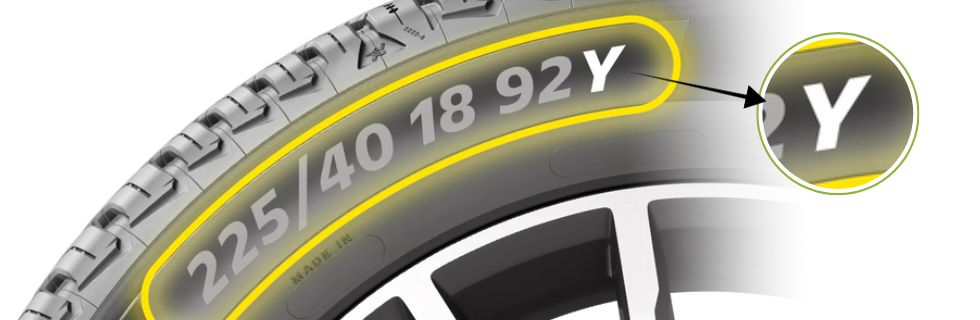
Every passenger tyre sold in the UAE carries its complete specification on the sidewall, moulded into the rubber during manufacturing. The full tyre size and rating string follows a standardised format that, once understood, communicates everything needed to verify that a replacement tyre matches the vehicle manufacturer's requirements. A typical tyre sidewall code might read: 225/55 R17 97V. In this example, 225 is the tyre width in millimetres, 55 is the tyre profile or aspect ratio (sidewall height as a percentage of width), R indicates radial construction, 17 is the rim diameter in inches, 97 is the load index (indicating the maximum load capacity each tyre can support), and V is the speed rating or speed symbol.
Beyond the basic size string, drivers should also locate the DOT code on the tyre sidewall, which reveals the manufacture date of the tyre in its final four digits—the first two indicating the production week and the last two indicating the year. A tyre manufactured in week 34 of 2020, for example, will show "3420" at the end of its DOT string. In the UAE's heat-accelerated thermal degradation environment, this date is critically important: a tyre may have adequate tread depth and retain its speed symbol designation, but if the tyre DOT code indicates it is more than five years old, the rubber compound may have undergone sufficient ozone cracking and molecular hardening to meaningfully compromise its ability to perform to its rated specification.
The UTQG (Uniform Tyre Quality Grading) rating, which appears on some tyres as a set of numbers and letters such as "400 A A," provides additional context by communicating treadwear rating, traction rating, and temperature resistance grade—three dimensions of tyre capability that complement the speed and load ratings and give a fuller picture of how a tyre will perform under real-world stress.
When a tyre carries a ZR designation, this appears before the R in the size string—for example, 245/40 ZR18 97Y—indicating an ultra-high-performance tyre rated for speeds above 240 km/h, with the specific maximum speed confirmed by the accompanying W or Y speed symbol at the end of the size string. Drivers replacing tyres on performance vehicles should pay close attention to this detail, as fitting a tyre without the correct ZR designation on a vehicle that specifies it can affect both safety and, in the event of an accident, insurance validity.
Choosing the Right Speed-Rated Tyre for Your Vehicle in the UAE
Matching or Exceeding the OEM Specification
The foundational principle of tyre speed rating selection is straightforward: the replacement tyre must carry a speed rating equal to or higher than the specification listed in the vehicle owner's manual or on the placard inside the driver's door jamb. Fitting a lower-rated tyre is never an acceptable substitution, regardless of cost considerations. Fitting a higher-rated tyre is generally permissible, though there are nuances—some manufacturers note that exceeding the OEM speed rating may affect ride quality or rolling resistance marginally, as higher-rated tyres tend to use stiffer compounds and constructions. In practice, for most drivers in the UAE operating standard passenger vehicles, moving one category above the OEM specification yields meaningful safety margin with no perceptible negative effect on day-to-day driving. The one area where drivers should exercise particular caution is Run Flat Tyres: these carry their own speed and load rating designations, and replacing a run-flat with a standard construction tyre—or vice versa—without adjusting the vehicle's TPMS (Tyre Pressure Monitoring System) calibration and Electronic Stability Control (ESC) parameters can introduce handling inconsistencies that the driver may not immediately detect.
Considering Load Index Alongside Speed Rating
Speed rating and load index work together as a paired specification, and both must be matched to the vehicle's requirements. A tyre with an appropriate speed rating but insufficient load range or maximum load capacity will be structurally overloaded under the vehicle's weight, which degrades performance, accelerates tyre wear rate, and introduces its own set of safety concerns. Larger SUVs and pickup trucks—vehicles extremely popular across the UAE—often carry substantial gross vehicle weight ratings (GVWR), and buyers should confirm both specifications when selecting replacements rather than relying on speed rating alone as the qualifying criterion. Drivers should also account for vehicle load distribution: a heavily loaded rear axle on a pickup truck or SUV places disproportionate demands on the rear tyre pair, and selecting a load index that provides adequate margin above the axle's maximum load capacity is as important as selecting the correct speed symbol.
Seasonal and Climate-Specific Compound Considerations
Unlike markets with four distinct seasons, the UAE does not require drivers to switch between summer and winter tyres. However, the extreme heat of the Gulf summer does place specific demands on tyre durability and compound chemistry. All-season tyres, while popular in other markets, are typically formulated for a thermal window that includes cold temperatures below 7°C—conditions that are irrelevant in the UAE and that mean the compound's energy goes into maintaining flexibility that is simply not needed locally. High-speed-rated tyres engineered for European performance markets may use silica compound formulations optimised for wet grip in cool, wet European conditions, while Gulf-specific variants may prioritise carbon black-reinforced compounds with higher thermal stability and resistance to heat cycle fatigue.
Several major premium tyre brands now produce variants of their popular models specifically formulated for Middle Eastern conditions, using compounds with higher temperature resistance grade thresholds and reinforced carcass structures better suited to sustained heat exposure. When selecting a replacement tyre in the UAE from a tyre retailer UAE or tyre fitment centre, choosing a product from a manufacturer's Gulf or Middle East specific range—where available—provides compound characteristics better aligned with local operating temperatures than a general-market equivalent with identical speed and load ratings.
The Risk of Budget Tyres and Counterfeit Products in the UAE Market
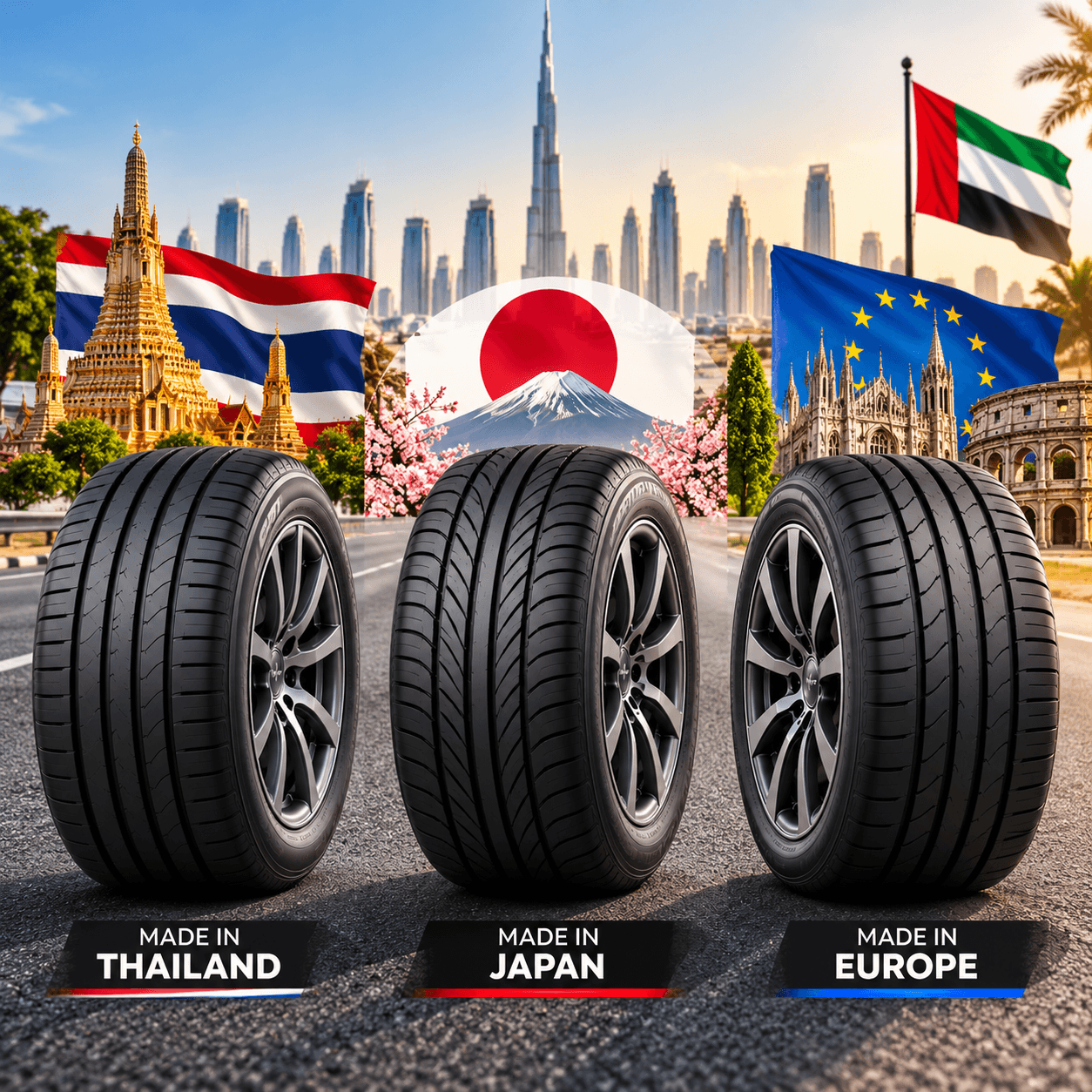
One dimension of tyre selection that deserves dedicated attention in the UAE context is the proliferation of budget tyre options and, more seriously, counterfeit tyres that mimic the appearance and markings of premium tyre brands without meeting their engineering standards. The UAE's position as a major regional import and re-export hub means that the local tyre market contains products from a very wide range of origins, and not all carry the manufacturing integrity that their sidewall markings claim. A counterfeit tyre may display a speed symbol of V or W on its sidewall while its actual carcass structure, steel belt layers, and tread compound have been manufactured to substantially lower standards, meaning its real-world speed capability falls well short of the printed rating. Purchasing tyres exclusively from authorised tyre fitment centres and established tyre retailers UAE, checking for TÜV certification documentation, and verifying DOT codes against manufacturer databases are all practical steps UAE drivers can take to reduce exposure to sub-standard products. The cost difference between a counterfeit or severe budget tyre and a genuine mid-range product from an established manufacturer is rarely significant enough to justify the structural and safety risk, particularly in a market where highway speeds and ambient temperatures are as demanding as they are in the Emirates.
Common Mistakes UAE Drivers Make With Tyre Speed Ratings
One of the most frequently observed errors is purchasing tyres based on size alone, without verifying the speed rating suffix. Online marketplaces and some lower-tier tyre retailers list tyres by size with the speed rating displayed prominently only on closer inspection, and buyers focused on price comparison may overlook this distinction entirely. A 225/55 R17tyre is available in H, V, and W ratings at meaningfully different price points, and the temptation to select the least expensive option without confirming the rating is understandable but potentially dangerous. Tyre brand comparison conducted purely on price without accounting for speed symbol, tyre durability, and temperature resistance grade is one of the most common decision-making errors observed in the UAE replacement tyre market.
A second common error involves fitting mismatched speed ratings across an axle—for example, fitting two V-rated tyres on the front axle and two H-rated tyres on the rear. Vehicle dynamics, particularly under high-speed emergency manoeuvres and emergency lane changes, depend on consistent tyre performance characteristics across each axle. Mismatching speed ratings introduces asymmetries in tyre compliance and heat behaviour that can produce oversteer or understeer tendencies and unpredictable handling responses at the speeds commonly achieved on UAE highways. Anti-lock Braking System (ABS) and traction control system calibration is performed by the vehicle manufacturer assuming matched tyre specifications across all four positions; mismatched ratings can cause these systems to receive inconsistent inputs from the tyre-road interface, potentially reducing their effectiveness precisely when they are most needed. Tyre professionals universally recommend matching all four tyres to the same specification wherever possible, and at minimum ensuring that both tyres on the same axle carry identical ratings.
A third mistake is failing to account for the load index reduction that applies when a tyre is fitted to a vehicle with a temporary spare wheel. Compact spare wheels, often called "space savers," carry severely restricted speed ratings—typically S or T—and using them at UAE highway speeds is both unsafe and contrary to their design intent. Drivers who carry a compact spare should be aware of this restriction and plan accordingly if a tyre failure occurs on a highway journey. A related and increasingly common alternative is the run-flat tyre, which eliminates the need for a spare entirely by allowing continued travel at reduced speed after a puncture—but run-flats carry their own specific speed and load designations, and not all TPMS (Tyre Pressure Monitoring System) configurations are equipped to alert the driver correctly when a run-flat has been punctured without immediate pressure loss.
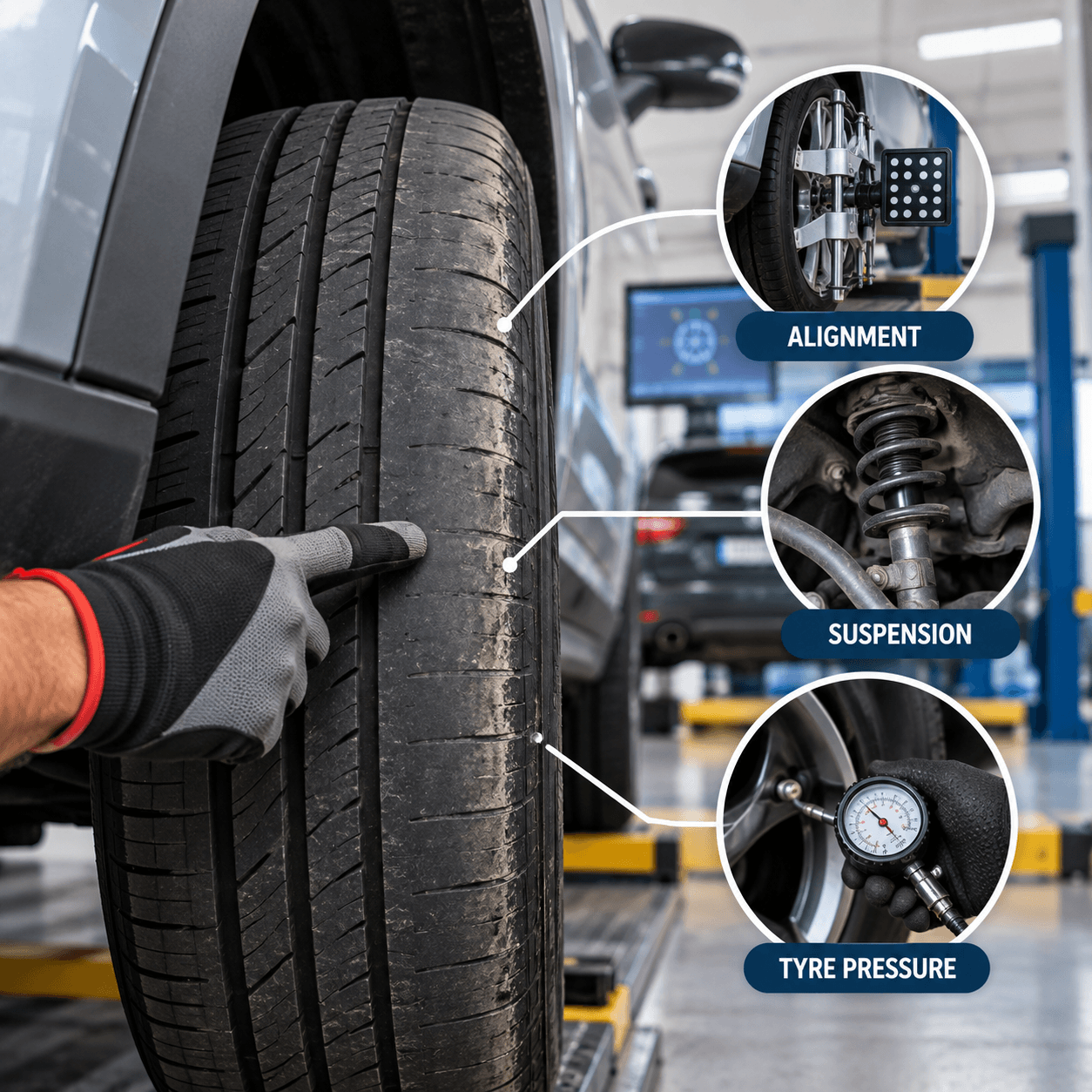
Neglecting tyre rotationtyre rotation and wheel alignment is a fourth frequently overlooked error that indirectly affects speed rating performance. Uneven wear caused by misaligned wheels means that tyres on the same axle develop different tread depth profiles, which alters their heat management characteristics and can cause one tyre to reach unsafe operating temperatures before the other. Regular tyre balancing is equally important—an imbalanced tyre develops localised wear patterns at the tyre contact patch that generate higher friction heat at specific points during rotation, concentrating thermal stress in ways that effectively reduce the tyre's real-world capability below its rated speed performance.
Legal and Insurance Implications of Incorrect Tyre Ratings in the UAE
The UAE's traffic laws and vehicle roadworthiness standards require that vehicles be maintained in a condition consistent with their manufacturer's specifications, which explicitly includes tyre fitment. The UAE Federal Traffic Law and associated Ministry of Interior traffic regulations treat tyre condition as a component of vehicle roadworthiness, and motor vehicle inspection criteria applied during RTA vehicle inspection and Tasjeel / Wasel vehicle registration renewal processes include tyre assessment.
While routine roadside checks do not always include tyre specification verification, vehicles involved in accidents may be subject to technical inspection, and incorrectly specified tyres could be cited as a contributing factor. Drivers should be aware that a traffic fine for unsafe tyres is also a possibility during targeted enforcement campaigns that periodically occur across the Emirates. More significantly, vehicle insurance policies in the UAE typically contain clauses requiring the insured vehicle to be maintained in a roadworthy condition consistent with manufacturer specifications. A claim arising from an accident where non-specification tyres—including those with an incorrect speed rating—were fitted could be challenged by insurers, potentially resulting in a reduced settlement or claim rejection. The financial and legal exposure created by fitting incorrect tyres in the UAE far outweighs any cost saving achieved at the point of purchase.
Maintaining Speed Rating Integrity: Inflation, Load, and Condition
A tyre's speed rating is predicated on it being correctly inflated and not overloaded. Underinflation is one of the most significant contributors to heat build-up at speed, and in the UAE's summer temperatures, an underinflated tyre can reach critical internal temperatures within a relatively short distance of high-speed driving. The UAE Roads and Transport Authority and multiple automotive safety organisations recommend checking tyre pressures monthly and before any long highway journey, using the vehicle manufacturer's specified cold inflation pressure rather than the maximum pressure moulded on the tyre sidewall. Drivers are encouraged to use a reliable tyre pressure gauge and, where available, consider nitrogen inflation as an alternative to standard compressed air—nitrogen's larger molecular structure reduces the rate of pressure loss through the tyre wall and produces more stable pressure readings across the temperature range experienced in the UAE's climate, from cool morning temperatures to the peak afternoon heat of July and August.
The TPMS (Tyre Pressure Monitoring System) fitted to most vehicles manufactured after 2010 provides a dashboard warning when tyre pressure drops below a set threshold, but drivers should not rely on this system alone: TPMS typically does not alert until pressure has dropped by 25% or more below the specified level, by which point significant structural stress may already be occurring. Using a tyre pressure gauge for manual checks remains the most reliable method of maintaining correct inflation between TPMS alerts. Tyre sealant products, while useful for managing minor punctures in the short term, can interfere with TPMS sensor function and should not be used as a substitute for prompt professional repair or replacement.
Tyre condition is equally important: a tyre approaching or below the legal tread depth limit of 1.6 mm (though many specialists recommend replacement at 3 mm for UAE conditions given the demands of desert driving and sandy terrain on tread pattern integrity) cannot safely perform to its rated speed, regardless of its technical specification, because tread depth directly influences heat dissipation, wet grip performance, and hydroplaning resistance during the UAE's brief but intense rain events. Tyre age cracking or ozone cracking—the fine surface fissures that develop in aged rubber exposed to UV radiation and ozone—is a particular concern in the UAE's intense solar environment.
A tyre exhibiting visible ozone cracking on its sidewall or tread compound surface, even if it retains adequate tread depth, should be considered for immediate replacement, as these cracks indicate that the compound's molecular structure has degraded to a point where its speed and thermal rating can no longer be relied upon. The tyre warranty period offered by manufacturers typically extends five to six years from the manufacture date shown in the DOT code, and a pro-rata tyre warranty may apply within this period for manufacturing defects—but age-related degradation in the UAE's climate can make this warranty period effectively shorter than the manufacturer's general-market recommendation.